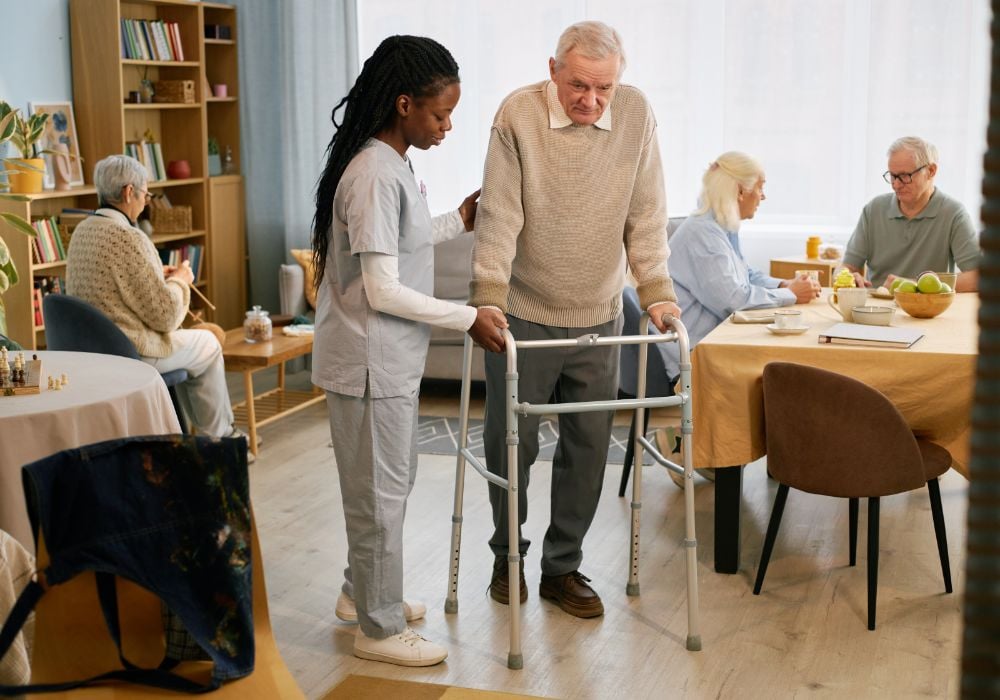
Adult family homes are independently licensed residential care businesses that serve older adults and people with disabilities throughout Washington. AFH providers carry major responsibilities: operating a home, employing and supervising caregivers, meeting state licensing requirements, protecting vulnerable residents, and managing the financial realities of round-the-clock care.
Because many AFHs serve residents whose care is paid for through Medicaid, decisions made by the State of Washington directly affect provider reimbursement, training, benefits, grievance procedures, and other economic issues. The organization certified as the exclusive bargaining representative speaks for every provider in the statewide bargaining unit on those subjects whether or not an individual provider belongs to that organization.
This page explains how that system developed, how the Washington State Residential Care Council commonly known as RCC or WSRCC became the bargaining representative, how the 2008 provider election unfolded, how RCC later became known as the Adult Family Home Council, and why meaningful elections remain important, and why WAAFHA is collecting signature to force an election in 2027.
Washington State
How adult family home providers in Washington came to be represented — and why the question of choice still matters.
1993 – 2026 Statewide bargaining unit The historical record
1993
In 1993 the Washington State Residential Care Council (RCC) was formed with a specific purpose and mission — to represent and defend the interest of Vulnerable Adults.
For many years, before collective bargaining was created for AFH providers, RCC functioned as an association supporting and advocating for vulnerable adults as stated in their mission.
2007 · The law
In 2007, the Washington Legislature enacted a collective-bargaining framework for adult family home providers. The law treated participating AFH providers as public employees only for collective-bargaining purposes; it did not make providers state employees for other purposes.
The framework established one statewide bargaining unit and made the Governor or the Governor’s designee the public employer for bargaining.
The law also defined the subjects of bargaining:
Economic compensation and Medicaid reimbursement
Health and welfare benefits
Professional development and training
Labor-management committees
Grievance procedures and other economic matters
2007 · Certification
The original certification procedure is an essential part of this history. RCW 70.128.043 directed the American Arbitration Association to compare an organization’s authorization cards with Department of Social and Health Services records. If the comparison showed majority support, that organization would be certified as the sole statewide representative.
In other words, the initial selection process was a card cross-check. It was not the same as a secret-ballot election in which every eligible provider was sent a ballot and given a choice among competing organizations or no representation.
2008 · The vote
In January 2008, adult family home providers voted in a contested representation election between the Residential Care Council and the Washington Federation of State Employees. The reported tally was:
Reported tally · January 2008
Residential Care Council 606
Washington Federation of State Employees 548
RCC prevailed by 58 votes · 1,154 ballots counted
That election is the only contested statewide provider representation election that WAAFHA has identified in the publicly available historical record. WAAFHA continues to seek complete official records so the history can be documented as accurately and transparently as possible.
2009 and after
After certification and bargaining, the representative negotiated agreements with the State concerning the limited subjects authorized by law.
Washington’s Office of Financial Management continues to publish the biennial agreements covering the AFH bargaining unit.
2016 · A new name
In 2016, the Residential Care Council adopted the name “Adult Family Home Council”. The change in name did not create a new bargaining unit or automatically trigger a new representation election.
The Adult Family Home Council remains identified by the State as the exclusive bargaining representative for the statewide AFH provider unit.
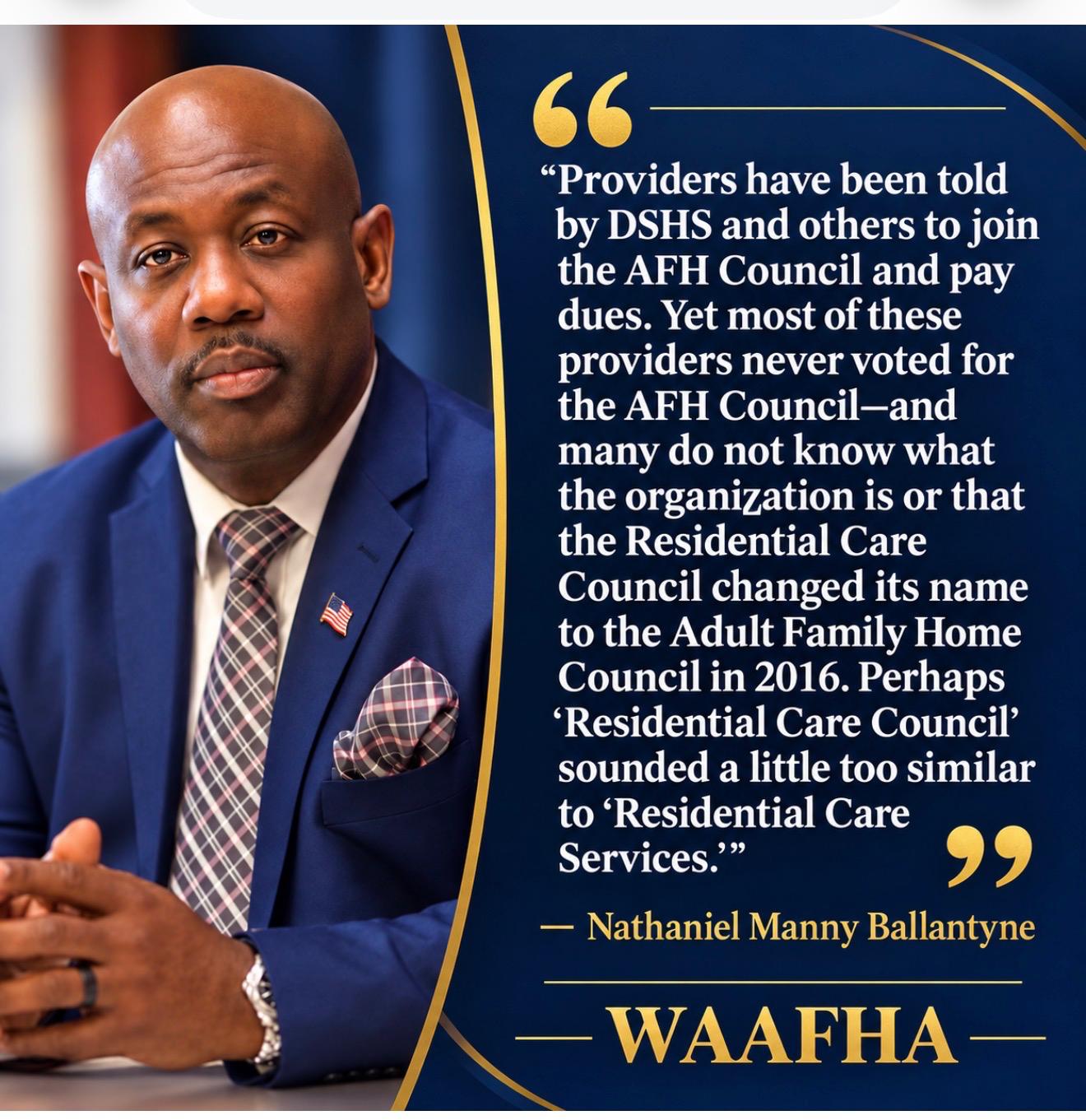
Technically, AFH Council has never been through an election voted by providers.
2026 · Until now
In 2008, there were less than two thousand providers in the state of Washington. In 2026, the number of providers has increased threefold to over six thousand.
2008 < 2,000
2026 > 6,000
None of these providers have had an opportunity to choose their bargaining representative until now.
A public history compiled for adult family home providers · Washington State
What “Exclusive Bargaining Representative” Means
An exclusive bargaining representative has authority to bargain with the State for the entire bargaining unit. It does not bargain only for its voluntary members. Its negotiations may affect Medicaid reimbursement, benefits, training, grievance procedures, and other economic conditions for all covered providers.
This is different from ordinary membership in a trade association. A provider may decide whether to join an association, but the certified bargaining representative speaks at the bargaining table for everyone in the legally defined unit.
Washington law now states that the representative for the statewide AFH unit is the representative chosen through the applicable representation process. It also provides that AFH providers are public employees solely for collective bargaining and not for other purposes.

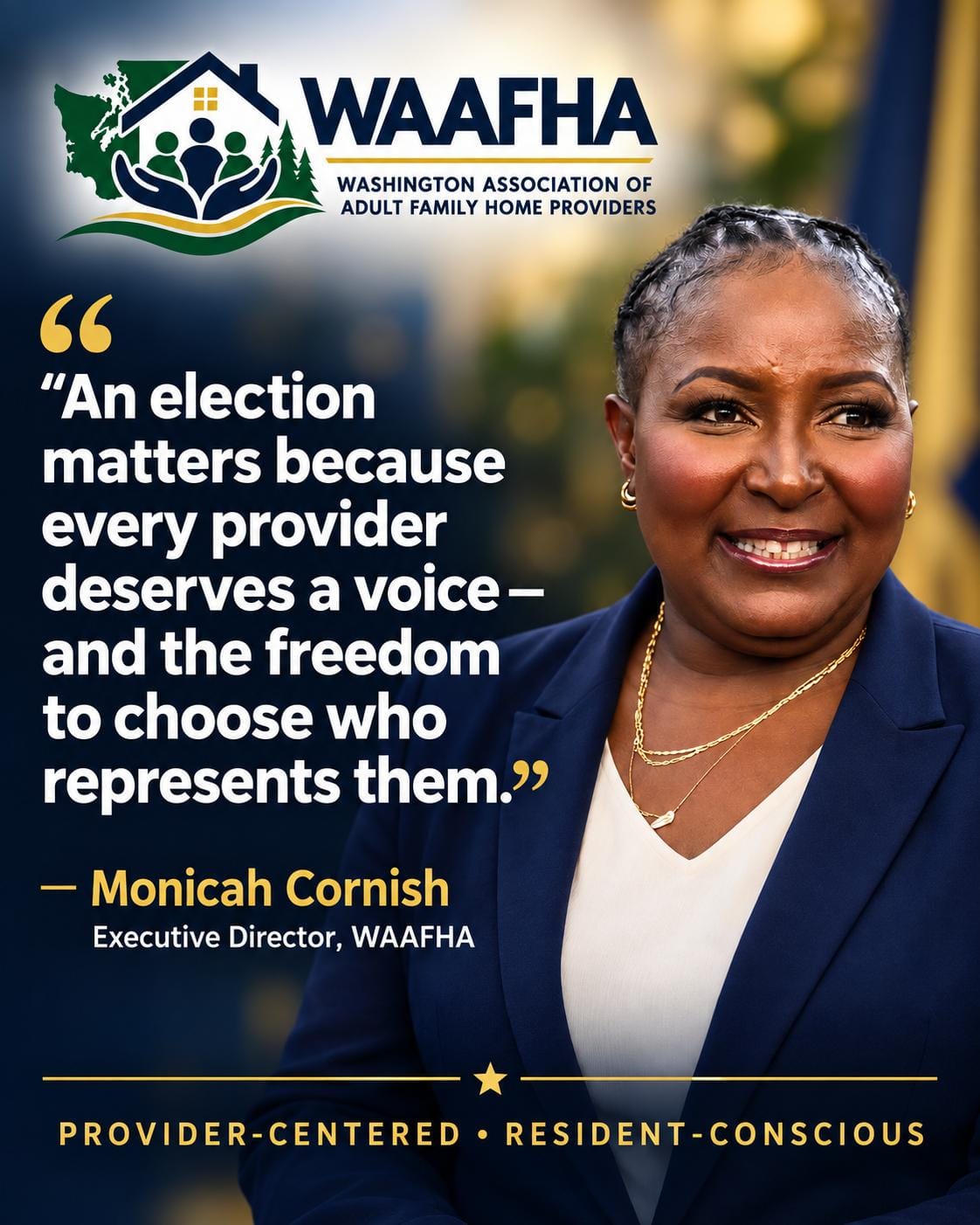
The Washington Association of Adult Family Home Providers (WAAFHA) was founded by providers, is owned by providers, and is led by providers.
A representation election is not merely a contest between organizations. It is a process for determining whether the current providers those whose businesses, residents, employees, and livelihoods are affected today consent to the organization exercising exclusive bargaining authority.
For far too many years, Washington’s Adult Family Home providers have not had the strong, independent representation they deserve. Decisions affecting our homes, caregivers, residents, and livelihoods have often been made without providers having a meaningful voice at the table.
WAAFHA was created to change that.
The 2008 election established a provider choice at that moment in history. But many current AFH providers were not licensed, operating, or eligible to vote at that time. The industry has grown, the cost of care has increased, regulations have expanded, and the needs of residents and providers have changed.
A historical election remains legally significant, but it does not answer every question about present-day support. That is why transparent representation procedures and the lawful ability of providers to request a new election are important safeguards. A new election would not erase the past; it would allow the present-day bargaining unit to confirm or change its representation through a fair process.
WAAFHA believes AFH providers should understand how statewide representation began, what authority an exclusive bargaining representative exercises, and how providers can lawfully participate in the representation process. WAAFHA supports an informed, transparent, provider-driven election conducted under applicable Washington law and administered by the appropriate neutral authority.
Our purpose is straightforward: providers should have a meaningful voice in choosing the organization authorized to represent them in negotiations that affect their homes, caregivers, residents, and financial sustainability.
If you are an adult family home provider and want more information about the history of provider representation, the election process, or WAAFHA’s organizing work, contact us.
Email: info@wafha.org
Every provider deserves accurate information, a meaningful voice, and the opportunity to make an informed choice.